
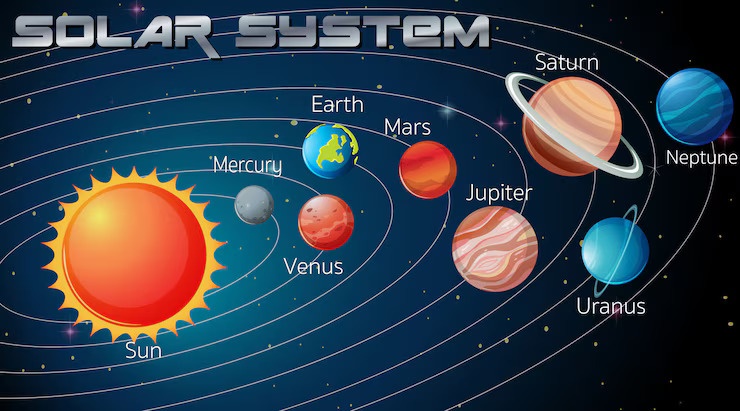
the solar system
Our solar system is an amazing place with many fascinating features. It is made up of the Sun, eight planets, their moons, asteroids, and comets. Let's take a closer look at this incredible cosmic neighborhood. The Sun is at the center of our solar system. It is a massive, blazing ball of gas that provides heat and light to all the planets. Without the Sun, life on Earth wouldn't exist. Mercury is the closest planet to the Sun. It is a small, rocky world with extreme temperature variations. During the day, it can get scorching hot, while at night, it becomes incredibly cold. Venus is often called Earth's "sister planet" because it is similar in size and composition. However, Venus has a thick, toxic atmosphere that traps heat, making it the hottest planet in our solar system. Earth is our home planet and the only one known to support life. It has a diverse range of ecosystems, including oceans, forests, and deserts. Mars is often called the "Red Planet" due to its reddish appearance. It has a thin atmosphere and is home to the tallest volcano and the deepest, longest canyon in the solar system. Jupiter is the largest planet in our solar system. It is a gas giant with a massive storm known as the Great Red Spot. Jupiter has a strong magnetic field and dozens of moons. Saturn is famous for its stunning ring system, which is made up of countless ice and rock particles. It is the second-largest planet and has a complex system of rings and moons. Uranus and Neptune are known as the "ice giants" because they are composed mostly of icy materials. Both planets have rings and a variety of moons. Asteroids are rocky objects that orbit the Sun, mainly found in the asteroid belt, located between Mars and Jupiter. Some asteroids are quite large, while others are small. Comets are icy objects with tails that can be seen when they get close to the Sun. They travel in elongated orbits and are often called "dirty snowballs."